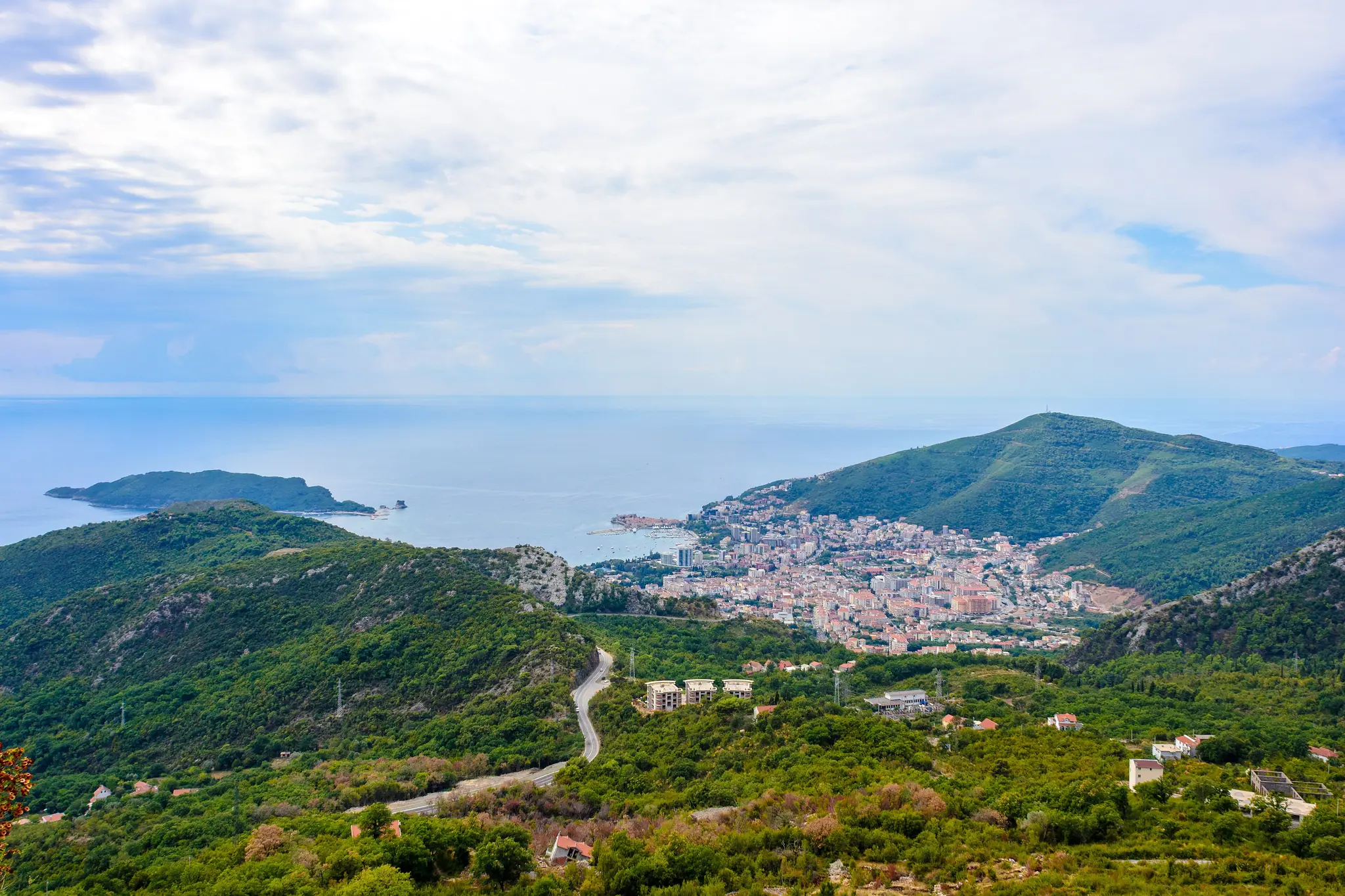
Montenegro offers an international buyer an unusual combination: freehold title in your own name, the euro, a flat 15% tax on rent and on gains, and EU accession talks that are close to the end. On the official record, the average price of a new flat rose from EUR 1,194 per square metre in 2021 to EUR 2,557 in the second quarter of 2026, and foreign money keeps arriving. The risks are just as real. Resale is thin, the season is short, planning has grey areas and the rules change. Weigh both sides before you choose a town or a home.
Montenegro at a glance for an investor
| Factor | What the record shows | Date |
|---|---|---|
| Currency | The euro, sole legal tender | Since March 2002 |
| EU accession | 23 of 33 chapters provisionally closed; government target of membership by 2028 | 6 November 2026 |
| Foreign ownership | Homes and building land in your own name; farmland, forest and border land restricted | Law in force |
| Tax on rent and on gains | 15% | August 2026 |
| Tax when you buy | 21% VAT on a new build, or 3% to 6% transfer tax on a resale; no stamp duty | 2026 |
| Annual property tax | 0.25% to 1% of market value; 0.3% to 1.5% on a second home | 2026 |
| New flats, average price | EUR 2,557 per sqm nationally, EUR 2,838 on the coast | Q2 2026 |
| Foreign investment in real estate | EUR 497.40 million | 2025 |
| Tourism | About 2.73 million arrivals and 15.37 million overnight stays | 2025 |
| Residence through property | Temporary residence; non-EU applicants need a EUR 150,000 tax base | Since 17 January 2026 |
The euro, without the euro area
Montenegro made the euro its sole legal tender in March 2002, after a period on the Deutsche Mark, according to the Central Bank of Montenegro. If you live in euros, there is nothing to convert: the price, the rent and the sale proceeds are all in your currency. Since Montenegro entered the Single Euro Payments Area in October 2025, a transfer from a euro account in the EU is a SEPA payment, which the Chambers 2026 guide notes has made cross-border payments simpler.
The euro does not make Montenegro part of the euro area. The European Commission's 2026 report says Montenegro has no standard monetary policy tools, which leaves fiscal policy as its main economic lever, and that its use of the euro is "fully distinct from membership of the euro area". In May 2026 Montenegro accepted the EU's approach to adopting the euro formally after accession. If you earn in another currency, the euro is a risk as well as a convenience: see the section on currency below.
EU accession: a target, not a date
Montenegro opened accession talks in June 2012 and has opened all 33 negotiating chapters. On 6 November 2026 it provisionally closed chapters 1 and 12, which brought the total to 23. The Commission's enlargement report says the talks "could realistically be closed by the end of the year" once Montenegro has implemented the necessary reforms. European Affairs Minister Maida Gorčević said in April 2026 that Montenegro is on track to become the EU's 28th member by 2028.
Treat 2028 as the government's target. A provisional closure becomes final only with an overall agreement, and the EU can return to a closed chapter. European Western Balkans reports that an accession treaty could be signed in June 2027, after which Montenegro and all 27 member states must ratify it.
What accession would change for owners is clearer than when it will happen. The Commission notes that Montenegro has ensured that all restrictions on EU citizens buying real estate and land, farmland included, will be lifted on accession. What it would do to prices cannot be known in advance. The Croatia precedent shows how prices moved in one neighbour, and EU accession and property covers the legal changes.
Taxes: 15% on rent and on gains
Rental income is taxed at 15%. The tax base is the rent less documented costs, or less a standard 30% where the costs are not documented, and PwC's summary gives standard costs of 50% and 70% for lettings to tourists. A gain on selling property is also taxed at 15%, and the sale of your only and main residence is exempt (PwC, August 2026).
When you buy, you pay VAT or transfer tax, not both:
- A new build from the developer carries 21% VAT instead of transfer tax (Chambers 2026). Ask whether the price you are quoted includes it.
- A resale carries real estate transfer tax, paid by the buyer, in bands that have applied since 1 January 2024: 3% up to EUR 150,000, then EUR 4,500 plus 5% of the amount above EUR 150,000, and EUR 22,000 plus 6% of the amount above EUR 500,000 (Ministry of Finance).
- Building land with a building permit has carried VAT since 1 April 2026 (KPMG).
- Stamp duty does not exist (PwC).
Each year your municipality charges property tax at 0.25% to 1% of market value, or 0.3% to 1.5% on a second home that is not your registered residence, under the Law on Real Estate Tax. The detail is in property taxes and buying costs, VAT or transfer tax on new builds and annual property tax. Put your own price into the calculator:
The price and the sale
The notary and your advisers
Total cost of buying
€851
An estimate: 0.2% of the agreed price, paid on top of it. VAT is already in the price.
- VAT21% on a developer's first sale, in place of transfer tax. Normally within the price: check the contract says so
- In the price
- Notary and cadastre registrationThe 2026 notary tariff for a contract of EUR 350,000, with 21% VAT and the fee to file the registration
- €851
- Price plus costs
- €350,851
In short
Plan for €350,851 in all. The price already carries about €60,700 of VAT, so a new build bought from the developer pays no transfer tax.
Rates reviewed on 15 November 2026. Transfer tax since 1 January 2024: 3% to EUR 150,000, 5% from there to EUR 500,000, and 6% above, on the market value. The notary figure follows the notary tariff in force from 9 April 2026; the cadastre’s own registration fee is nominal and not included. Your lawyer’s and any agent’s fees are your own quotes. An estimate, not a quotation. See VAT or transfer tax on new builds and property taxes and buying costs.
Send me this breakdown
Your figures by email, and an adviser to check them against the contract of a real development.
Email me the breakdown
Freehold ownership in your own name
A foreign individual or company can own an apartment, a house or building land in Montenegro in its own name, as a Montenegrin can. The Law on Property Relations restricts categories, not nationalities. Under Article 415, a foreign person may not own natural resources, public-use goods, agricultural land, forests and forest land, cultural monuments of exceptional and special significance, property within 1 km of the land border or on islands, or areas closed to foreigners by a special law. A foreign individual may buy up to 5,000 square metres of farmland or forest only with a house standing on it, and foreigners may hold long-term leases and concessions over the restricted categories.
Title passes only when you are registered in the real estate cadastre, whatever the date of the contract. The cadastre is public and its entries are presumed accurate, which is why title insurance is generally not used (Chambers 2026). The Commission adds a caution: Montenegro has still to finish mapping its cadastre. Check a specific property with the ownership navigator, and read can foreigners buy property in Montenegro?
Price growth on the official record
Monstat, the statistical office, records the prices of new flats sold under contract. It does not measure resales or asking prices.
| Period | Montenegro, EUR per sqm | Change |
|---|---|---|
| 2021 | 1,194 | |
| 2025 | 2,200 | +84% on 2021 (calculated) |
| Q2 2025 | 2,201 | |
| Q2 2026 | 2,557 | +16.2% on a year earlier (calculated) |
In the second quarter of 2026 the coastal region averaged EUR 2,838 per square metre, Podgorica EUR 2,510 and the northern region, which includes Kolašin and Žabljak, EUR 2,145. The Central Bank's Financial Stability Report for 2025 names foreign direct investment in real estate and housing loans as the main drivers, and rates the real estate market an increased risk to financial stability. It expects price growth to stabilise at a relatively high level.
Past growth is no forecast. The long series back to 2006 is in capital growth in Montenegro, and the latest quarter in the Montenegro property market in 2026.
Tourism and rental demand
Tourism drives the economy. The Commission estimates that it accounts directly for 20% to 25% of GDP. Monstat's monthly data add up to 2.73 million tourist arrivals and 15.37 million overnight stays in 2025 (calculated), and preliminary figures for January to September 2026 show arrivals up 10.3% and nights up 9.0% on a year earlier (calculated).
Private accommodation, the market a holiday let competes in, recorded 10,179,395 overnight stays in 2025. Foreign tourists accounted for 99.6% of them and seaside resorts for 94.8%. The largest markets were Serbia, with 25.6% of foreign nights, and Russia, with 22.1%, ahead of Bosnia and Herzegovina, Turkey, Ukraine, Germany, Kosovo and the United Kingdom.
Demand by town is in holiday-let demand by town and yields in rental yields by town. Test your own figures in the rental yield calculator before you rely on any projection.
Foreign money into Montenegrin property
Non-residents put EUR 497.40 million into Montenegrin real estate in 2025, 9.24% more than in 2024, out of total foreign direct investment inflows of EUR 1,018.01 million (Central Bank of Montenegro). From January to August 2026 the figure was EUR 319.01 million, 3.38% more than a year earlier. The Commission notes that foreign investment is concentrated in tourism, real estate and construction, and Chambers describes demand as driven largely by international buyers and cash purchases.
That money supports prices, and it is also a dependence: see liquidity below. Who is paying, and from where, is in who is buying property in Montenegro, wealth migration to Montenegro and foreign investment in Montenegro real estate.
Infrastructure and access
Montenegro's two airports, Podgorica and Tivat, handled 3,085,675 passengers in 2025, 7.4% more than in 2024, and 1,793,756 in the third quarter of 2026 alone, 28.4% more than a year earlier (Monstat). Wizz Air's base at Podgorica was due to open on 30 March 2026 with two aircraft, and the chief executive of Airports of Montenegro spoke of limited infrastructure capacity.
On the ground, the first 42 km of the Bar-Boljare motorway, from Podgorica to Mateševo, has been open since July 2022 (EBRD). In February 2026 the state road company Monteput signed a contract worth about EUR 694 million to design and build the next 23 km, to Andrijevica, backed by an EBRD loan and an EU grant. Monteput expects main works to start in mid-2027. Status, funding and dates for every major project are in infrastructure and regeneration projects, and flights by season in flights and getting around.
Residence through property
Owning a home can support a temporary residence permit. Since amendments to the Law on Foreigners took effect on 17 January 2026, an applicant from outside the EU, the EEA and Switzerland must show a real estate transfer tax decision with a tax base of at least EUR 150,000. A new build is sold with VAT rather than transfer tax, so if residence matters to you, ask a lawyer how you will prove the value before you sign.
Residence is not citizenship. Montenegro's citizenship by investment scheme ended on 31 December 2022, and the Commission records that only applications filed before then are still being decided. Routes and conditions are in temporary residence through property, and the residency pathfinder matches a route to your passport.
Prices against neighbouring markets
New homes still cost less on average than across the border. Croatia's Bureau of Statistics puts the average price of new dwellings sold in the first half of 2026 at EUR 3,012 per square metre, 8.9% more than a year earlier, and EUR 3,554 in Zagreb. Montenegro's average was EUR 2,557 in the second quarter of 2026, and EUR 2,838 on the coast. Both offices count sales under contract rather than asking prices, and Montenegro's coastal resorts ask far more than either average, as the area pages show.
Taxes and fees change the comparison. International buying costs sets a foreign buyer's purchase taxes and fees in Montenegro against other markets, and Montenegro vs Croatia compares ownership, tax and residence in the two countries.
The risks, with the same weight
Liquidity and resale
Resale is the weakest part of the case. Monstat's price series covers first sales of new flats only, and the Central Bank's survey of owners' prices covers Podgorica alone, so neither official series shows what resale homes on the coast fetch. Demand rests heavily on foreign buyers paying cash. In the Central Bank's 2025 survey of estate agencies, 71.4% of the 28 that replied expected foreign demand to fall in 2026. On a resale your buyer pays 3% to 6% transfer tax and you pay 15% on the gain, so buying and selling again has a real cost. Plan to hold for years, and read selling property and capital gains tax.
Seasonality
The season is short. July and August brought 45.6% of all tourist nights in 2025 (calculated from Monstat). Tivat Airport, on the Bay of Kotor, handled 54,782 passengers in the first quarter of 2026 and 815,020 in the third. A holiday let earns much of its year in two months, so model the winter honestly. The season explorer shows each month, and short-term rental rules covers registration and the tourist tax.
Legalisation and planning
Building without permits is common. By August 2026 the Real Estate Administration had received more than 80,000 requests to record illegally built structures in the cadastre. Planning rules can change around you: since March 2026 no permits for new buildings have been issued in Kotor's protected area, and in July 2026 the government decided to draw up a new spatial plan for the coast. Buy only with a building permit, a use permit and a clean title sheet. See illegal construction and legalisation and title deeds and due diligence.
Rule changes
Rules that matter to buyers have changed often:
- Residence. The EUR 150,000 tax base for non-EU applicants took effect on 17 January 2026.
- Visas. A decree adopted in July 2026 ended visa-free entry for citizens of Belarus, China, Russia, Saudi Arabia and Turkey from the end of October 2026. Russian tourists alone accounted for 22.1% of foreign nights in private accommodation in 2025.
- Tax. Transfer tax bands of 3% to 6% have applied since January 2024, and VAT reached building land with a permit in April 2026.
- Citizenship. The investment route closed at the end of 2022.
Leave a margin in any plan that depends on a rule, and check the current position before you sign.
Political risk
Governments in Montenegro rest on coalitions. The Commission's 2026 report records that one coalition party left the ruling majority in January 2026, which led to the resignations of the deputy prime minister for infrastructure and the transport minister, and a reshuffle followed in July. It still describes a broadly stable environment, with EU accession as the government's central objective, and national elections are due in June 2027. Agreements with the UAE and the United States exempt some investment projects from public procurement rules, and the Commission has asked Montenegro to make sure they do not circumvent EU law.
Construction and off-plan risk
If you buy off-plan, you pay before the home exists. You become the owner only on registration, and a building may be used only once a use permit has been issued after a technical inspection (Chambers 2026). Until then your money depends on the developer finishing. Tie payments to construction stages, check the building permit and the developer's record, and plan the payments with the off-plan payment planner. The off-plan buying process sets out the contract terms to ask for.
Currency for non-euro buyers
The price, the rent and the sale proceeds are in euros, so if you earn in dollars, pounds or francs you carry exchange risk. At the European Central Bank's reference rate, one euro bought USD 1.0198 on 13 January 2025 and USD 1.1974 on 28 January 2026. The same euro price therefore cost 17.4% more in dollars at the top than at the bottom (calculated). Against the pound, the range from January 2025 to November 2026 was narrower, at 7.2%. Plan when you convert, and read sending money to Montenegro.
How to choose
- Decide what the home must do. A holiday home, a rental, a base for residence and a long-term hold point to different towns. Where to buy in Montenegro and the area matchmaker narrow the search.
- Match the place to the use. Tivat, Porto Montenegro and Luštica Bay are close to Tivat Airport and the marinas. Kotor offers heritage under a building freeze, Budva beaches and a busy summer, Herceg Novi and Portonovi the western bay, Bar and Ulcinj the south coast and the sand of Velika Plaža, Podgorica a capital that works all year, and Kolašin and Žabljak the mountains. Compare pairs in Kotor vs Tivat, Tivat vs Budva and Kolašin vs Žabljak.
- Price the whole purchase. Use the purchase cost calculator and the running cost calculator, and read running costs of property in Montenegro.
- Test the income. Run the rental yield calculator with your own occupancy, and read rental income and tax and rental yields in Montenegro.
- Check the title and the building. Follow how to buy property in Montenegro and title deeds and due diligence. For a resort home, read resort and branded residences.
- Plan the money and the structure. Sending money to Montenegro, mortgages for foreigners, buying through a Montenegrin company, managing property from abroad and inheritance and wills cover the rest.
When you have a shortlist, the homes we sell are on property for sale in Tivat and property for sale in Kolašin, and every development is under developments.