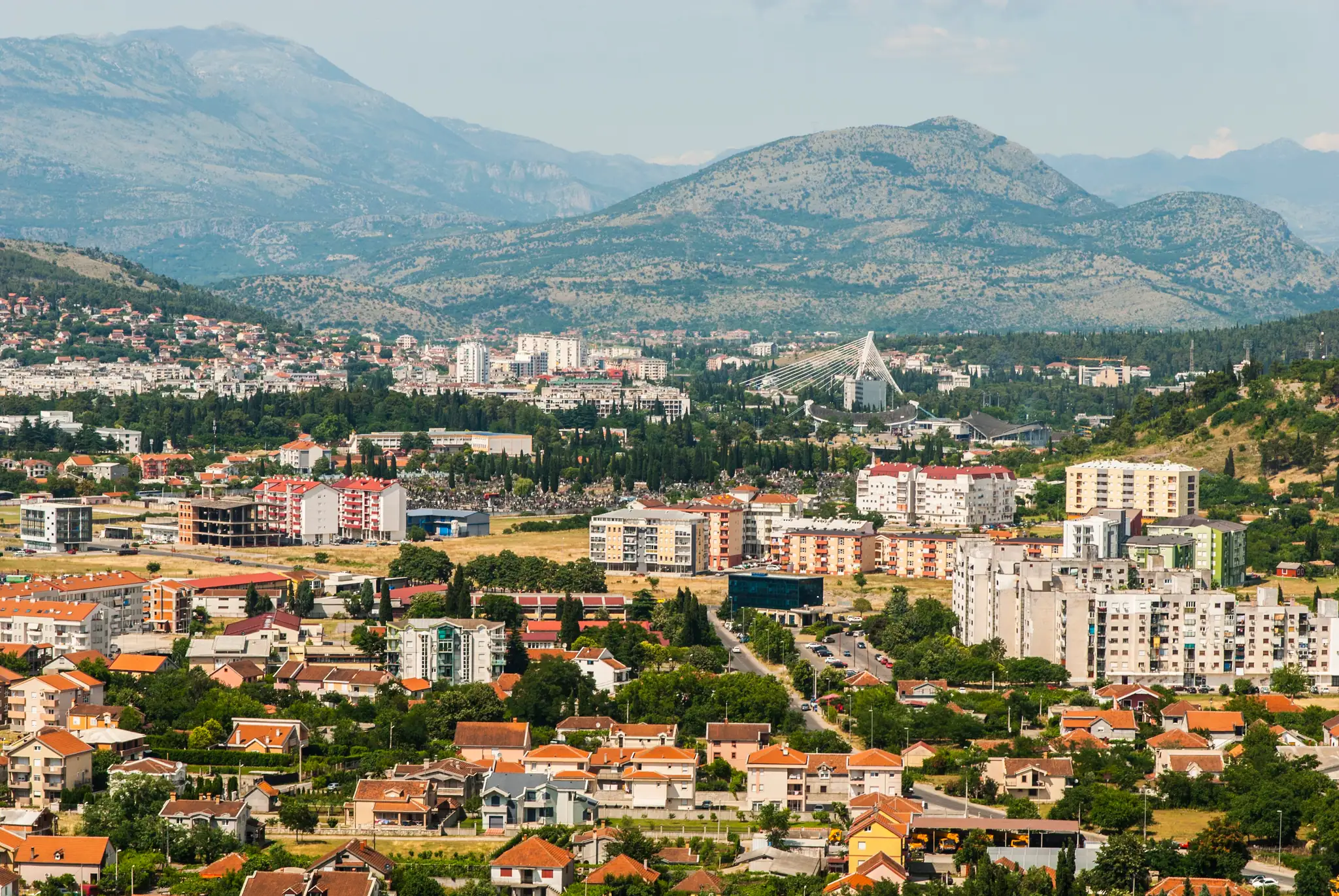
A Montenegrin mortgage is possible for a foreign buyer, but it is not the norm. Hipotekarna banka is the bank that states plainly that it lends to non-residents investing in Montenegrin property, on shorter terms than it offers residents. Other banks lend to foreigners who live and work in Montenegro. Chambers' 2026 guide describes the market as driven by "international buyers and cash transactions", and most buyers from abroad fund the purchase themselves.
Which banks in Montenegro lend to non-residents?
| Bank | Who can borrow | Amount and term | Rate (published) | Own contribution |
|---|---|---|---|---|
| Hipotekarna banka | Residents, and non-residents investing in Montenegrin property | Set by income and price; up to 20 years for residents, 10 years for non-residents | Fixed only, 4.99% to 7.50% | 20% of the price |
| OTP banka (formerly CKB) | Residents, and non-residents with employment and a regulated stay in Montenegro | EUR 10,000 to EUR 300,000, 12 to 360 months | Fixed or variable; example 4.99% fixed, or 2.99% plus six-month Euribor | Ask the bank |
| NLB Banka | Applicants with proof of employment and a salary account at NLB | Up to 360 months | Fixed from 5.19%, variable from 2.79% plus six-month Euribor | Ask the bank |
Terms are the banks' own, published in August to October 2026, and they change. A bank decides each application on your income, your credit record and the property, so treat the table as a guide to who to ask, not an offer.
Mortgage rates and terms in 2026
- Rates. Fixed rates start at about 5%. Variable loans are priced as a margin over six-month Euribor, which OTP banka gave as 2.687% on 17 August 2026. A fixed rate gives certainty; a variable rate moves with Euribor for the life of the loan.
- Effective rate. The EKS (efektivna kamatna stopa) adds fees and insurance to the interest. Hipotekarna banka's example of EUR 120,000 over 20 years at 4.99% has an EKS of 5.18% and a monthly instalment of EUR 783.97. OTP banka's example of EUR 100,000 over 30 years at 4.99% fixed has an EKS of 5.15%.
- Age. The last instalment must fall before you turn 65 at Hipotekarna banka and 67 at OTP banka, which shortens the term for older buyers.
- Currency. Loans are in euros.
Documents a Montenegrin bank will ask for
Expect the bank to ask for:
- your passport, and a residence permit if you hold one;
- proof of income: an employer's confirmation, or tax returns if you are self-employed;
- the preliminary contract with the seller or developer;
- a recent title sheet for the property;
- a valuation by the bank's approved valuer, which you pay for.
Security is a first-ranking mortgage on the property, registered in the cadastre, with promissory notes and a building insurance policy assigned to the bank. A resident borrower also gives an assignment of salary. Montenegrin law allows a mortgage over any identified property that can be sold, and Chambers notes there is in principle no bar to security in favour of a foreign lender.
The extra costs of a Montenegrin mortgage
The banks' own examples show the extras:
- property valuation: EUR 80 at OTP banka, EUR 90 at NLB;
- title sheet extract: EUR 5 to EUR 8;
- mortgage registration in the cadastre: EUR 25 at OTP banka;
- notarised pledge statement, at the notary's tariff;
- building insurance for the life of the loan, and life insurance if you choose it.
These sit on top of transfer tax or VAT and the other buying costs, which no bank finances.
How much Montenegro borrows for homes
Lending to buy homes is growing fast from a low base. The Central Bank reports that housing loans to individuals grew 20.8% in 2025, with new housing loans of EUR 232.7 million in the year, and that housing loans still equal less than 10% of GDP, against more than a third on average in the EU. Its lending survey found banks eased credit standards for housing loans in every quarter of 2025. For a non-resident, the practical question is not whether banks lend, but whether one will lend to you on terms that suit you.
Alternatives: payment plans and loans at home
A developer's payment plan. Many off-plan developments sell with staged payments over construction, so you pay part on reservation and the balance by completion. Portonovi, for example, advertises its new Marina Apartments with a 20% down payment. A plan spreads the cost without a bank, but your money is committed before the home exists: read the off-plan buying process on what protects each instalment, and lay the schedule out in the off-plan payment planner.
Borrowing at home. Releasing equity from a home you already own, or a loan from your own bank, lets you borrow in the currency you earn, secured on property you already hold. Compare its effective rate and term with a Montenegrin offer.
Paying from your own funds. It is the simplest route, with no loan approval to wait for. See sending money to Montenegro for the euro transfer and the documents your bank will ask for.
Mortgages for residents of Montenegro
Moving changes the picture. A buyer who holds a residence permit and works in Montenegro can apply to OTP banka for up to 30 years, against Hipotekarna banka's 10 years for non-residents, and other banks open up once you have a local salary account. If you plan to move, ask each bank what it would offer you after you arrive, and consider buying first with your own funds and refinancing later. Residence routes are set out in temporary residence through property and company and work residence.
Currency risk on a euro mortgage
A euro loan repaid from income in pounds, dollars, francs or lira exposes you to the exchange rate for every instalment. A 10% fall in your currency against the euro raises the cost of each euro instalment by about 11% in your money. If your income is not in euros, fix the rate for the deposit and consider borrowing in the currency you earn.
The home and its plan
Your currency
Your view of value
Paid before handover
EUR 975,601
70% of the price, before the keys. The balance of EUR 418,115 falls due at handover, in month 2.
- When you sign the contract: Down payment20% of the price
- EUR 278,743
- In instalments during construction: Construction instalments50% of the price
- EUR 696,858
- After handover, in interest-free instalments: After handover30% of the price
- EUR 418,115
- Total
- EUR 1,393,716
Value at handover, your assumption
EUR 1,393,716
At zero change, the price you agreed.
Against the price
EUR 0
On paper only, before the costs of buying and selling.
In short
You commit EUR 1,393,716 across 3 payments: 70% before handover and 30% at it.
The schedule is the one published for Heights Residences, Luštica Bay, completion Q4 2027. The reservation agreement governs; check it before you pay. Converted at the reference rates of 13 November 2026 (European Central Bank reference rates via frankfurter.dev); your bank’s rate and margin will differ. The currency and value figures are your assumptions, not forecasts: we do not predict prices or exchange rates. Every payment is in euros, Montenegro’s only legal tender, and Montenegro has been part of the Single Euro Payments Area since October 2025, which makes transfers in euros from Europe simpler. See sending money to Montenegro.
Sources for these figures
Talk it through
An adviser can confirm the current schedule and price list, and set the payment dates against your transfers.
Send me this payment plan
Your schedule by email, payment by payment, with an adviser to check it against the developer's current terms.