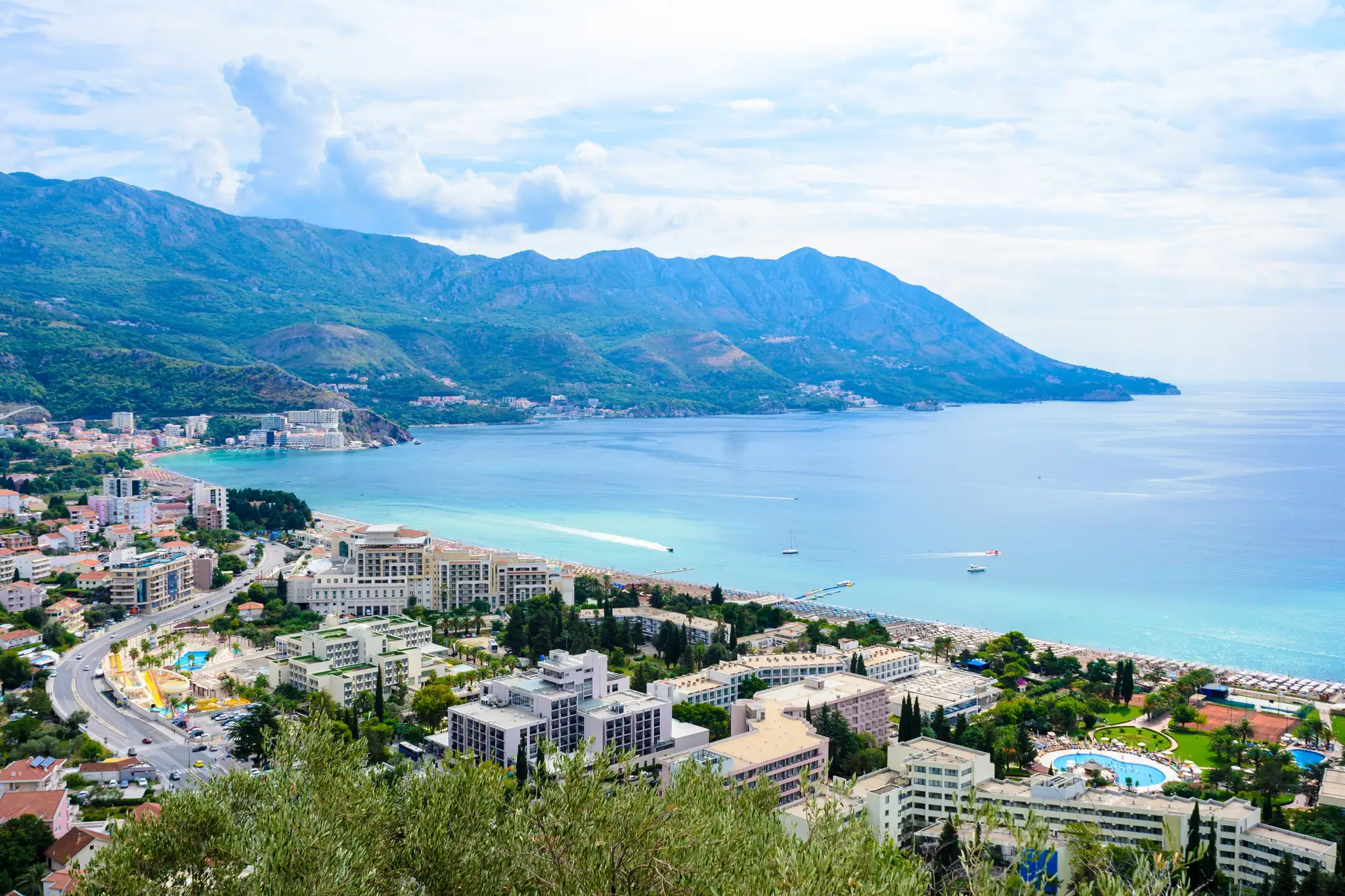
Holiday-let demand in Montenegro is on the coast and in the summer. In 2025 private accommodation, the flats, houses and rooms that owners let, recorded 10,179,395 of the country's 15,367,166 tourist nights, and the six coastal municipalities had 94.8% of them (Monstat). Budva is the largest market, followed by Herceg Novi, Bar, Tivat, Ulcinj and Kotor. For an owner the towns differ in what matters most: how long the season lasts, how long guests stay, where they come from and how many other homes compete for them.
Holiday lets and hotels by town in 2025
Monstat counts every registered tourist night in two kinds of accommodation. Collective accommodation is hotels, resorts, boarding houses, hostels and camps. Individual, or private, accommodation is rooms, flats and houses let by their owners: the market a holiday-let owner competes in.
| Municipality | Arrivals | Nights | Holiday-let nights | Hotel nights | Holiday-let share |
|---|---|---|---|---|---|
| Budva | 884,794 | 4,970,193 | 2,672,881 | 2,297,312 | 53.8% |
| Herceg Novi | 380,677 | 2,752,428 | 1,900,700 | 851,728 | 69.1% |
| Bar | 260,176 | 2,217,381 | 1,741,428 | 475,953 | 78.5% |
| Ulcinj | 312,677 | 1,509,750 | 1,100,980 | 408,770 | 72.9% |
| Tivat | 166,819 | 1,429,084 | 1,198,935 | 230,149 | 83.9% |
| Kotor | 275,971 | 1,350,610 | 1,034,477 | 316,133 | 76.6% |
| Podgorica | 211,395 | 409,960 | 68,049 | 341,911 | 16.6% |
| Kolašin | 69,570 | 172,343 | 76,827 | 95,516 | 44.6% |
| Žabljak | 52,020 | 149,983 | 99,913 | 50,070 | 66.6% |
| Montenegro | 2,728,564 | 15,367,166 | 10,179,395 | 5,187,771 | 66.2% |
Source: Monstat, annual data on total accommodation 2025, release 26-2/2026 on individual accommodation (final) and the twelve monthly releases on collective accommodation in 2025 (final). Hotel nights are the sum of the monthly releases, which equals each town's total less its private accommodation exactly. Shares calculated.
Budva has a third of the country's nights, and it is also the most hotel-heavy resort on the coast: hotels took 46.2% of its nights. Holiday lets dominate in Tivat (83.9%), Bar (78.5%) and Kotor (76.6%). Podgorica is the opposite case: five of every six nights are in hotels and visitors stay under two nights, so a flat in the capital is a long-let investment. Rental yields by town sets out what each market pays.
How the holiday-let market changed from 2023 to 2025
| Municipality | Nights 2023 | Nights 2024 | Nights 2025 | Change in 2025 | Average stay 2023 | Average stay 2025 |
|---|---|---|---|---|---|---|
| Budva | 3,365,144 | 3,120,302 | 2,672,881 | -14.3% | 11.9 | 9.5 |
| Herceg Novi | 2,172,741 | 1,985,611 | 1,900,700 | -4.3% | 10.6 | 8.9 |
| Bar | 1,902,860 | 1,615,968 | 1,741,428 | +7.8% | 11.8 | 11.9 |
| Tivat | 1,083,527 | 1,085,973 | 1,198,935 | +10.4% | 13.7 | 14.2 |
| Ulcinj | 1,364,710 | 1,153,818 | 1,100,980 | -4.6% | 5.5 | 5.1 |
| Kotor | 1,029,552 | 1,046,822 | 1,034,477 | -1.2% | 7.5 | 6.3 |
| Žabljak | 74,819 | 76,119 | 99,913 | +31.3% | 4.2 | 3.7 |
| Kolašin | 46,677 | 58,543 | 76,827 | +31.2% | 5.2 | 3.7 |
| Podgorica | 43,562 | 53,746 | 68,049 | +26.6% | 4.2 | 3.6 |
| Montenegro | 11,264,298 | 10,393,405 | 10,179,395 | -2.1% | 9.6 | 8.3 |
Source: Monstat, releases on individual accommodation for 2023, 2024 and 2025 (final data). Changes and average stays, in nights per arrival, calculated.
The national total hides two movements. Holiday-let arrivals rose 5.8% in 2025 while nights fell 2.1%, because the average stay shortened from 9.0 to 8.3 nights. And one market explains the fall since 2023: Russian guests' nights in private accommodation dropped from 3,578,276 to 2,242,468, a loss of 1,335,808 nights, more than the 1,084,903 the whole market lost. Nights from all other foreign markets together rose 3.3%.
Budva shows both effects most clearly: about the same number of arrivals as in 2023, but stays cut from 11.9 to 9.5 nights and nights down 20.6%. Tivat moved the other way, with 6.4% more arrivals in 2025 and longer stays. Kolašin, Žabljak and Podgorica grew by more than a quarter, from small bases.
The season: holiday lets peak harder than hotels
Monstat publishes holiday lets by town only for the year, but the national figures come month by month: total nights less hotel nights gives the holiday-let month.
| 2025 | Holiday lets | Hotels |
|---|---|---|
| Share of nights, June to September | 69.5% | 67.9% |
| Share of nights, July and August | 48.2% | 40.5% |
| Share of nights, November to March | 15.3% | 9.3% |
| Guests a night in August | 82,810 | 34,238 |
| Guests a night in January | 9,173 | 2,383 |
| Season in full nights | 123 | 152 |
Source: Monstat, monthly data on total accommodation and monthly releases on collective accommodation, 2025. Holiday-let figures are total less collective accommodation; all shares and averages calculated.
Almost half of the year's holiday-let nights fell in July and August. Winter is not empty, at 9,000 to 11,000 guests a night from December to March, but those figures can include foreigners staying for months as well as holidaymakers (see the notes on the data below).
The last line turns the curve into one number: the year's nights divided by an average night in the busiest month. A home full on every night of August that followed the national holiday-let pattern in the other months would be let for about 123 nights: 85 between June and September and 38 in the other eight months. It is an upper guide for a home that follows the market, not a forecast.
The shoulders are where demand is growing. On preliminary figures for 2026, total tourist nights rose 15.2% in June and 14.9% in September on a year earlier, against 10.1% in July and 8.5% in August.
Which towns have a longer season
Month-by-month figures by town exist only for hotels, but they show the shape of each town's demand.
| Municipality | June to September | July and August | December to March | Season in full nights |
|---|---|---|---|---|
| Podgorica | 43.5% | 22.3% | 20.4% | 267 |
| Kolašin | 43.6% | 25.6% | 29.7% | 228 |
| Kotor | 65.5% | 36.9% | 5.1% | 166 |
| Tivat | 63.3% | 37.4% | 10.4% | 164 |
| Herceg Novi | 64.4% | 37.4% | 7.0% | 160 |
| Žabljak | 66.7% | 40.0% | 14.7% | 149 |
| Budva | 69.0% | 41.4% | 5.1% | 147 |
| Bar | 86.6% | 54.7% | 3.7% | 113 |
| Ulcinj | 83.7% | 52.8% | 0.5% | 109 |
Source: Monstat, monthly releases on collective accommodation, 2025 (final data). Shares of each town's hotel nights and full nights calculated.
Monstat's own grouping shows the contrast between coast and mountains: seaside resorts' hotels took 70.8% of their nights from June to September, mountain resorts' 53.2%, with 26.3% from November to March. For holiday lets the mountains are small, with 2.6% of the country's private-accommodation nights in 2025 against 94.8% on the coast.
On the coast, Kotor, Tivat and Herceg Novi have the broadest seasons, with about 35% of their hotel nights outside June to September. Bar and Ulcinj depend most on the peak, and Ulcinj's hotels were all but empty from December to March. Kolašin is the only town here with a strong winter: December to March, the ski season, brought 30% of its hotel nights, while Žabljak's hotels are mainly a summer business. Nationally, holiday lets have a shorter season than hotels, 123 full nights against 152, so read each town's figure as an upper guide for a let.
How long guests stay
Guests in holiday lets stayed 8.3 nights per arrival in 2025, against 3.4 in hotels. On the coast the holiday-let average ran from 14.2 nights in Tivat and 11.9 in Bar to 9.5 in Budva, 8.9 in Herceg Novi, 6.3 in Kotor and 5.1 in Ulcinj. In the mountains and Podgorica it was under four.
Nationality matters as much as place. Russian guests in private accommodation stayed 14.0 nights on average, Ukrainian 11.0 and Serbian 9.6, against 6.5 for British and German guests and 5.4 for Israeli guests. Long stays mean fewer changeovers and less cleaning per night let; short stays, as in Kotor and Ulcinj, mean more turnover for the same nights.
Who the guests are, town by town
| Municipality | Three largest markets, share of nights | Russia, Turkey, Belarus and China |
|---|---|---|
| Budva | Serbia 20.6%, Russia 18.7%, Ukraine 6.3% | 24.8% |
| Herceg Novi | Serbia 30.6%, Russia 14.9%, Bosnia and Herzegovina 14.6% | 17.4% |
| Bar | Serbia 24.2%, Russia 23.5%, Bosnia and Herzegovina 9.5% | 26.9% |
| Tivat | Serbia 23.0%, Russia 18.0%, United Kingdom 6.7% | 24.0% |
| Ulcinj | Serbia 19.6%, Kosovo 18.6%, Bosnia and Herzegovina 10.3% | 3.4% |
| Kotor | Serbia 17.6%, Russia 14.4%, United Kingdom 9.7% | 25.4% |
| Podgorica | Serbia 10.0%, Israel 9.6%, China 9.2% | 21.5% |
| Kolašin | Israel 14.7%, Albania 9.1%, Serbia 8.1% | 10.7% |
| Žabljak | Serbia 22.6%, Israel 9.7%, Russia 5.9% | 8.0% |
Source: Monstat, annual data on total accommodation by municipality and country, 2025. Shares of all nights in each town, hotels and holiday lets together, calculated.
Serbia is the largest market almost everywhere. Kotor has the highest shares of British and American guests of the nine towns: 9.7% and 4.8% of its nights. Ulcinj is a regional market led by Serbia and Kosovo, and Israel is the largest source in Kolašin.
The mix is shifting. In private accommodation nationally, nights from the United Kingdom rose 13.7% in 2025, from the United States 16.4%, from France 12.5% and from Israel 35.0%, while nights from Russia fell 13.1%, from Turkey 7.4% and from Kosovo 10.3%.
The visa decree in force from 1 November 2026 leaves Russia, Turkey, Belarus and China off the list of countries whose citizens may enter without a visa; holders of a valid Schengen, UK or US visa or residence permit may stay 30 days. Those four countries supplied 27.6% of holiday-let nights in 2025, and about a quarter of all nights in Bar, Kotor, Budva and Tivat, against 3.4% in Ulcinj. Monthly figures from November 2026 onwards will show the effect. Entry rules by nationality are in visa-free entry and stays.
Where the competition is
| Municipality | Homes used only for business | Homes used seasonally | Holiday-let nights per such home |
|---|---|---|---|
| Tivat | 1,870 | 4,405 | 191 |
| Kotor | 503 | 5,469 | 173 |
| Herceg Novi | 673 | 11,700 | 154 |
| Budva | 7,782 | 11,252 | 140 |
| Bar | 898 | 14,869 | 110 |
| Ulcinj | 3,189 | 11,669 | 74 |
| Žabljak | 132 | 2,833 | 34 |
| Kolašin | 86 | 2,235 | 33 |
| Podgorica | 1,164 | 7,259 | 8 |
Source: Monstat, 2023 census of dwellings by use (release 43/2025) and individual accommodation 2025. Nights per home calculated.
Budva has the most homes given over to letting: 7,782 dwellings were used only for business at the 2023 census, 46.5% of all such homes in the country. Add hotels holding 46.2% of its nights and Budva is the most crowded market. Tivat and Kotor had the most holiday-let nights per home used seasonally or for business; Ulcinj had the fewest on the coast. The measure is rough, because many seasonal homes are never let and a night is one guest, but the order shows how many guests each competing home shares. In Podgorica, 90% of homes are used as permanent homes and the holiday-let market barely registers: let a flat there to residents.
Why nights are not income
- A night is one guest. A family of four staying a week is 28 nights and one booking.
- Registered stays are not all holidays. Visitors staying up to 12 months count as tourists, and Monstat builds its private figures partly from the Interior Ministry's register of foreigners' stays, so they can include people renting for months.
- Unregistered stays are not counted at all.
- The data has no prices. Income is the nights you let times the rate, and the rate in March is not the rate in August.
- Costs come first. Management, cleaning, platform commission, the service charge, property tax and 15% tax on the rent, after a standard deduction of 50% where residence tax was paid. See rental income and tax and the short-term rental rules.
What it means if you want to let
- Budva brings the most guests and the most competition. Holiday-let nights fell 14.3% in 2025 while hotel nights held steady, so judge a let on its exact location and building, and ask for its letting record.
- Tivat and Kotor have the longest coastal seasons on hotel data and the most demand per competing home. Tivat grew 10.4% in 2025, and Kotor has the highest shares of British and American guests.
- Herceg Novi is the second-largest market, with a broad season led by guests from Serbia and Bosnia and Herzegovina.
- Bar and Ulcinj are the most summer-dependent: plan on an income earned in July and August. Bar's guests stay long; Ulcinj's stay about five nights.
- Podgorica is a long-let market. Kolašin has two seasons and Žabljak one, both small and both up about 31% in 2025.
Test any home's numbers in the rental yield calculator, and see the month-by-month pattern in the season explorer.
About the data
- Definitions. Holiday lets are Monstat's individual (private) accommodation: rooms, flats and houses let by private owners. Hotels are collective accommodation. A night is one tourist staying one night; arrivals count registrations, so a guest who moves to a second property is counted twice.
- What is calculated. Hotel nights by town are the sum of Monstat's twelve monthly releases and equal the total less private accommodation. National holiday-let months are total less hotel nights. Shares, changes, average stays, nights per home and full nights are calculations from the published figures.
- What is not published. Private accommodation by town comes once a year, so the season by town is measured on hotels. Source markets by town cover hotels and holiday lets together. Monstat withholds monthly hotel figures for Andrijevica, Gusinje, Petnjica, Plav, Plužine, Šavnik, Tuzi and Zeta to protect confidentiality.
- Coverage. Monstat's private figures draw on local tourist organisations, the Central Tourist Register and the Interior Ministry's register of stays. Unregistered stays are missing. Figures for 2026 are preliminary.
- Census. Homes by use are as reported in October 2023; nights are for 2025.
The wider national picture, with 2026 to date, is in tourism and rental demand.