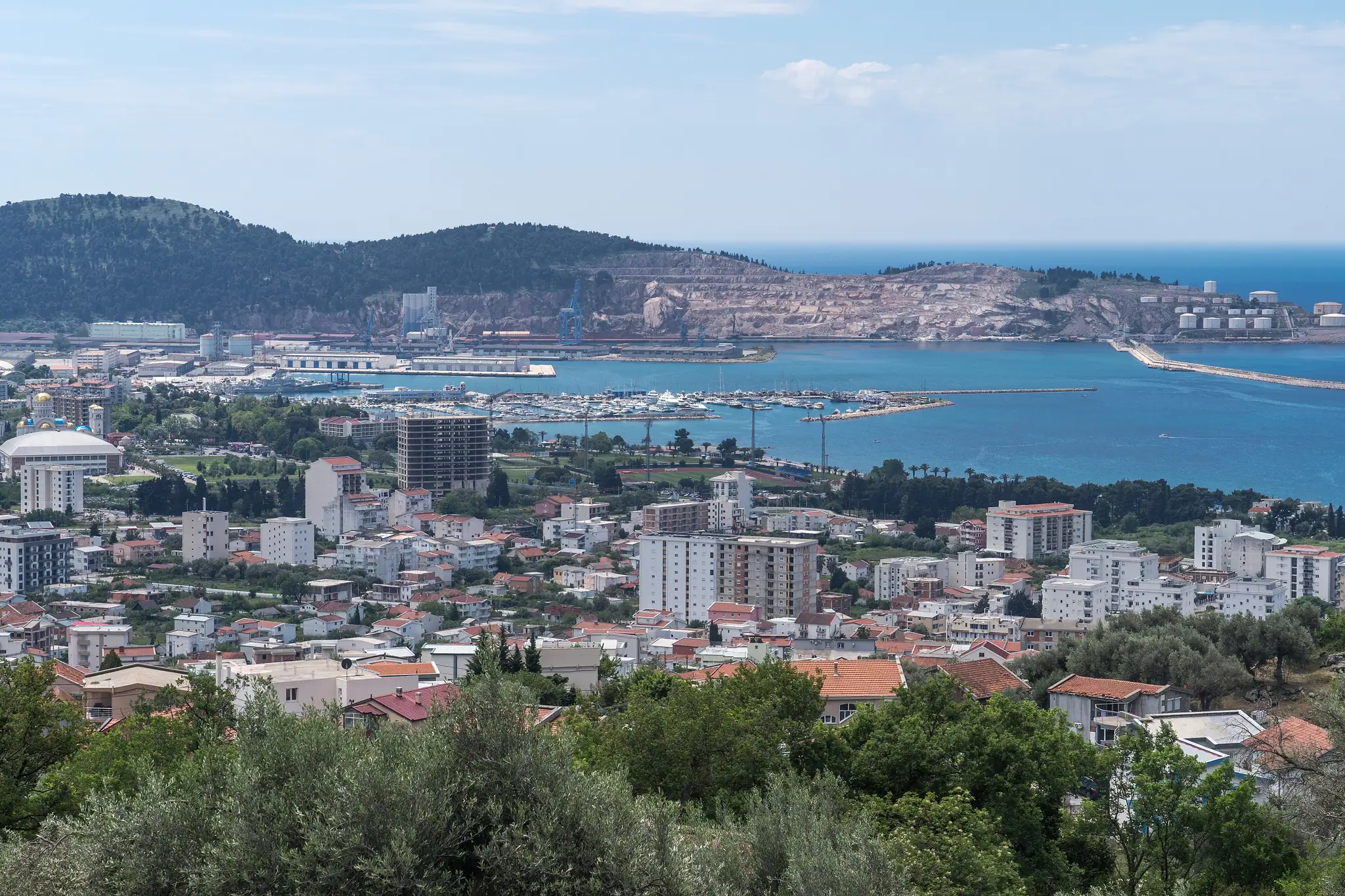
Living in Montenegro costs about two thirds of the EU average, but the saving is uneven. Electricity, restaurants and local services are cheap by European standards. Groceries are close to EU prices, and phone and internet cost slightly more. Within the country, the coast is dearer than Podgorica for eating out and rent, while the supermarket bill is much the same.
How Montenegro compares with the EU
Eurostat compares price levels across Europe each year, with the EU average set at 100. Its provisional figures for 2025, published in July 2026, put Montenegro at:
| Spending category | Price level, EU average = 100 |
|---|---|
| All household consumption | 66.1 |
| Food and non-alcoholic drinks | 86.5 |
| Restaurants and accommodation | 66.6 |
| Electricity, gas and other fuels | 45.9 |
| Information and communication | 106.1 |
For a buyer from Germany, Switzerland or Britain, the reading is simple. Energy and a meal out will feel cheap. A weekly shop of the brands you buy at home will not, and your phone and broadband bills will look familiar.
Wages and inflation in Montenegro
The average net monthly wage was EUR 1,043 in September 2026 and the gross wage EUR 1,245, according to Monstat, the national statistical office. In accommodation and food service, the sector that staffs the coast in summer, the average net wage was EUR 1,027. Local wages set the price of the services an owner buys, from cleaning to building work.
Prices are rising faster than pay. In September 2026 net pay was 2.7% higher than a year earlier, while consumer prices were 5.2% higher. By October 2026 annual inflation had reached 5.9%, up from 2.9% in January. Transport led the rise: fuel for cars cost 37.5% more than in October 2025. Food and non-alcoholic drinks rose 3.5%, restaurants and cafés 7.3%, and housing, water and energy 1.9%. Water supply charges fell 11.2% over the same year.
Grocery prices: close to the EU level
Food is where Montenegro is closest to EU prices, at 86.5% of the EU level in 2025. Two crowd-sourced price databases, Numbeo (November 2026) and Livingcost (June 2026), agree that staples cost much the same on the coast as in the capital:
| Item | Podgorica | Budva |
|---|---|---|
| Milk, 1 litre | EUR 1.17 | EUR 1.13 to 1.16 |
| White bread, 500 g | EUR 0.86 to 0.87 | EUR 0.82 to 0.94 |
| Chicken breast, 1 kg | EUR 7.49 to 8.10 | EUR 7.97 to 8.55 |
| Bottle of mid-range wine | EUR 5.50 to 5.70 | EUR 6.34 to 8.00 |
If you shop as you did at home, with the same brands and imported wine and cheese, budget close to home prices rather than at two thirds of them.
Eating out: Podgorica against Budva
Restaurants are where the saving shows, at 66.6% of the EU price level, and where the coast parts company with the capital:
| Item | Podgorica | Budva |
|---|---|---|
| Simple meal or lunch menu | EUR 9 to 10 | EUR 11 to 14 |
| Three-course dinner for two, mid-range, no drinks | EUR 34 to 40 | EUR 48 to 69 |
| Cappuccino | EUR 1.96 to 1.98 | EUR 2.63 to 3.07 |
| Half-litre of local beer in a bar | EUR 2.60 to 3.00 | EUR 3.20 to 4.25 |
Prices follow the season on the coast. Monstat recorded accommodation prices 9.9% lower in October 2026 than in September, and restaurant and accommodation prices overall 3.6% lower, as summer ended. See climate and seasons for how the year runs.
Electricity, water and fuel prices
Electricity is cheap. Households paid EUR 0.1039 per kWh in the first half of 2026, all taxes included, against an EU average of EUR 0.2832, according to Eurostat. In March 2026 the average household bill was EUR 39.73, and 57.98% of households paid under EUR 30, on figures from EPCG, the national electricity company. Tivat had the highest average bill, EUR 50.10, and Žabljak the lowest, EUR 20.30. A villa with a pool pump and air conditioning in every room will use several times the average, so ask the seller for a year of bills.
Water is billed by the municipal utility. In Podgorica, the price list in force from 1 January 2027 charges EUR 0.4084 per cubic metre for water, EUR 0.1859 for sewage and EUR 0.1505 for treatment, plus fixed charges of under EUR 1 a month, all before VAT. On the coast, ask for the local utility's bills for the property you are buying.
Fuel prices are capped each week by the Ministry of Energy. From 10 November 2026 the maximum was EUR 1.69 a litre for Eurosuper 95 petrol and EUR 1.95 for diesel. Running a car, and getting around without one, is covered in flights and getting around.
Phone and internet: the one cost above the EU average
Phone and internet are the one area priced above the EU average, at 106.1 in 2025. Home broadband of 50 to 60 Mbps or more costs about EUR 27 to 30 a month in both Podgorica and Budva. For a mobile line, Crnogorski Telekom and One both sell 30-day prepaid eSIMs with 1,000 GB of data for EUR 20. Setting these up is covered in banking and daily life, and fibre speeds for home working in remote work in Montenegro.
Rent in Podgorica and Budva, or the cost of owning
Both price databases put central Budva rents about a quarter above central Podgorica:
| Monthly rent | Podgorica, centre | Budva, centre |
|---|---|---|
| One-bedroom apartment | EUR 477 to 584 | EUR 597 to 731 |
| Three-bedroom apartment | EUR 866 to 1,206 | EUR 1,055 to 1,500 |
| Utilities for a family flat | EUR 91 to 116 | EUR 137 to 143 |
Averages hide a wide spread between an older flat and a new sea-view apartment in Tivat or on the Budva Riviera, so ask for rents in the specific building or resort you are considering. Buyers weighing rent against ownership can test both with the rental yield calculator.
If you own your home, the rent line becomes a service charge, the annual property tax, insurance and upkeep. Our guides to running costs and the annual property tax set these out, and the calculator below adds them up for a specific home.
The home
Annual real estate tax
Advanced: the value the tax is charged on
The municipality sets the market value on 1 January, from an average price per square metre and its own coefficients for location and quality, less an allowance for the building's age. EUR 2,200 is the price per square metre in Kotor's 2026 assessment, Monstat's 2025 average for new flats, before the municipality's own coefficient: a starting assumption. Your tax decision gives your figure.
Your own yearly costs
Letting
Yearly cost of keeping it
€1,386
About €116 a month, let or empty.
Share of the price
0.4%
Each year, before any rent.
Per sqm a month
EUR 1.65
All costs, on the interior area.
- Service chargeEUR 0 per sqm a month on 70 sqm
- €0
- Annual real estate tax0.9% of the municipality's tax base, a second home. Paid in two instalments, 30 June and 31 October
- €1,386
- InsuranceYour figure
- €0
- Utilities and internetYour figure, including standing charges while empty
- €0
- Care and repairsYour figure: inspections, cleaning, maintenance
- €0
- Reserve for replacementsYour figure: furniture, appliances, fittings
- €0
- Running costs a year
- €1,386
In short
Budget €1,386 a year to keep the home, before any rent. Add your own insurance, utilities and upkeep for the full figure.
The owner on 1 January pays the year’s real estate tax. The municipality issues the tax decision by 30 April, and the tax is paid in two equal halves, by 30 June and by 31 October. A new owner files a property tax return within 30 days of buying. These rules are from the law as consolidated on 30 March 2026. An estimate from your figures, not tax advice: see running costs explained and annual property tax.
Sources for these figures
- Law on Real Estate Tax, consolidated text to Official Gazette 133/2025, Ministry of Finance, 30 March 2026
- PwC Worldwide Tax Summaries: Montenegro, other taxes (reviewed 7 August 2026)
- Municipality of Kotor: regulatory impact assessment for amending its property tax decision, 2026
- Monstat: prices of dwellings in new residential buildings, 2025 (release 18/2026)
- PwC Worldwide Tax Summaries: Montenegro, income determination (reviewed 7 August 2026)
- PwC Worldwide Tax Summaries: Montenegro, taxes on personal income (reviewed 7 August 2026)
Talk it through
Ask for a building’s actual service charge, what it covers and the last two years of its accounts before you commit.
Send me these running costs
Your yearly costs by email, line by line, with an adviser to check them against a building's published charges.
Email me the costs
A monthly budget for living in Montenegro
On the two databases, one person's everyday costs in Podgorica come to about EUR 450 to 625 a month excluding rent, and a family of four's about EUR 1,400 to 2,250. These are averages for resident households. A couple who eat out several times a week, run a car and travel home often will spend more, and on the coast in summer more again.
Add the lines that averages leave out: private health insurance (see healthcare), school fees if you have children (see international schools), flights home, and household help. Retirees should also read retiring to Montenegro, and anyone comparing districts can weigh value against beaches, schools and quiet with the area matchmaker.