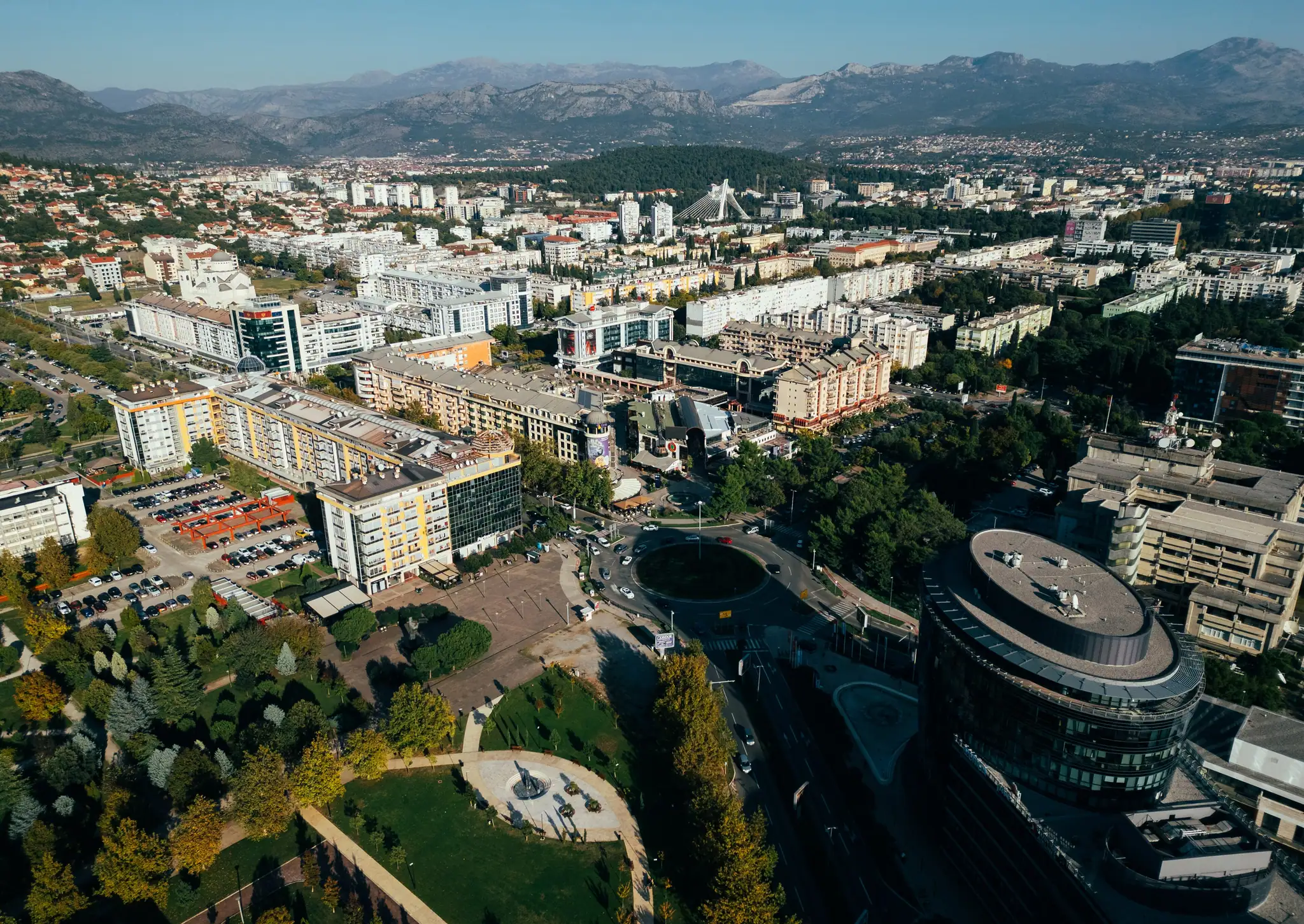
Montenegro has a public health system that a foreign buyer can use in an emergency and, once insured, for everything else, and a private sector for day-to-day care if you are not insured by the state. The national referral hospital is the Clinical Centre of Montenegro in Podgorica. On the coast, Kotor General Hospital serves Kotor, Tivat and Herceg Novi, and private polyclinics in Budva, Tivat, Bar and Herceg Novi cover routine care. Plan on private health insurance until you hold permanent residence.
How public healthcare works in Montenegro
The state scheme is run by the Health Insurance Fund (Fond za zdravstveno osiguranje) under the Law on Compulsory Health Insurance of 2021, amended in 2024. Care is arranged in three levels.
- Primary care. Each insured person registers with a chosen doctor (izabrani doktor), who treats, refers to specialists and prescribes the medicines on the Fund's list.
- Secondary care. General hospitals serve the regions. Kotor General Hospital, at Škaljari in Kotor, is one of seven in the country and the regional centre for Kotor, Tivat and Herceg Novi, with an emergency department, surgery, obstetrics, internal medicine and radiology.
- Tertiary care. The Clinical Centre of Montenegro in Podgorica is the referral hospital for the whole country and the teaching base of the University of Montenegro's Faculty of Medicine. It has 16 clinics, an Institute for Children's Diseases with two clinics, and seven centres.
There are also three special hospitals: Brezovik, Vaso Ćuković at Risan and the psychiatric hospital in Kotor. In January 2023 the government brought the hospital at Meljine, near Herceg Novi, which was in bankruptcy proceedings, back into the public system, run within Kotor General Hospital.
Insured patients pay a co-payment (participacija) on most services, from consultations to medicines and hospital stays. Children, pregnant women and new mothers, insured people over 65 and patients being treated for listed chronic conditions are exempt. The law also allows waiting lists for non-urgent tests and treatment. Private clinics are the alternative for anyone who will not wait.
Who can join Montenegro's state health scheme
Under the law, a foreigner becomes an insured person in three main ways:
- by working in Montenegro, as an employee, an entrepreneur or self-employed, while holding a temporary or permanent residence permit;
- as the spouse or child of an insured person, including on a temporary residence permit for family reunification;
- by holding permanent residence and not being insured on any other basis, on application to the Fund.
A person insured in another country that has a social security agreement with Montenegro cannot also be insured in Montenegro, unless that agreement says otherwise.
In practice, a buyer living on a temporary residence permit through property, without a job or a company in Montenegro, is not insured by the Fund unless an agreement between their own country and Montenegro gives them cover. Plan on private insurance until you hold permanent residence. The government's guidance states that time on a property-based permit does not count towards the five years of residence that permanent residence requires.
Health insurance is also a condition of every residence permit. The government lists it, with means of support and accommodation, among the requirements for both temporary and permanent residence.
Healthcare for visitors and short stays
Citizens of countries that have a social security agreement with Montenegro receive care to the extent that agreement sets. The UK is an example. Montenegro recognises the Global Health Insurance Card (GHIC), and a British visitor with a valid passport and a GHIC can obtain a certificate from the Health Insurance Fund for free or subsidised treatment at state facilities. Apply in advance, or as soon as possible after an emergency admission. Without the certificate you pay, and the bills cannot be reimbursed. Travel insurance that covers treatment and medical evacuation is still needed.
If you come from another country, ask your own health insurer or social security office before you travel whether an agreement applies. If none does, insure privately. How long you may stay without a permit is covered in visa-free entry and stays.
Private hospitals and clinics, from Podgorica to the coast
Private care is paid at the time of treatment, and it is the route for a foreign resident outside the state scheme. Podgorica has the widest choice.
Podgorica. Codra Hospital, on Radosava Burića street, has worked for more than 20 years and employs about 100 permanent staff. It covers most specialities, from cardiology, orthopaedics and neurosurgery to PET-CT imaging and hyperbaric medicine, and it describes its maternity ward as the first private one in Montenegro. The capital's other private hospitals include Ars Medica, Dr Medtim and Konzilijum, alongside polyclinics such as Diagnostica, Filipović, SmartMed and Moj Lab.
The coast. Budva has the Moj Lab polyclinic, the Consilium radiology clinic and the Otorina Prima ear, nose and throat clinic. Tivat has the Mansa Medica polyclinic. Bar has the Dr Zejnilović polyclinic, and A3 Medical runs a private hospital in Sutomore. In Herceg Novi, the Institute Dr Simo Milošević at Igalo specialises in rehabilitation, alongside the Delić Polymedic practice and the Mediterranean Surgical Centre. Ulcinj has a branch of Moj Lab.
The UK government's list of private medical facilities in Montenegro, updated in June 2025, includes all of these and marks most of them as English-speaking. It endorses none of them. Before you need care, check which clinics will bill your insurer directly.
Health insurance for residents and permit holders
Choose a policy that covers in-patient treatment in Montenegro and medical evacuation for the full term of your permit. An international policy suits owners who divide the year between countries; ask whether it pays Montenegrin private hospitals directly or reimburses you afterwards. Keep the policy certificate with your residence papers, because you will need it again when you renew.
Once you hold permanent residence, you can apply to join the state scheme, and insured people over 65 pay no co-payments. Keeping a private policy as well buys faster access to private clinics.
Emergency numbers: 112 and 124
Call 112 for any emergency. The 112 centre receives the caller's location automatically, and its operators can communicate in several languages. The direct numbers are 124 for an ambulance, 122 for the police, 123 for fire and rescue and 129 for help at sea. All of these calls are free.
For an urgent problem that is not life-threatening, go to the emergency department of the nearest general hospital. On the Bay of Kotor, that is Kotor General Hospital.
Medicines and pharmacies
Your chosen doctor prescribes the medicines on the Fund's list, and pharmacies dispense them with a co-payment. The Fund contracts private pharmacies as well, listed by town on its website, in places including Podgorica, Nikšić, Bar and Herceg Novi.
When you arrive, you may bring a reasonable amount of your own medication for personal use, up to six months' supply. Narcotic-based medicines are limited to 30 days, need a prescription or doctor's certificate less than 90 days old and must be declared at the border. Ask your doctor for a letter that names the active ingredients, because brand names differ.
Choosing an area with healthcare in mind
- Podgorica puts you closest to the Clinical Centre and to most private hospitals.
- On the Bay of Kotor, Kotor, Tivat and Herceg Novi share Kotor General Hospital, and Igalo has the rehabilitation institute.
- Budva and Bar have private polyclinics, and Sutomore a private hospital.
- In the mountains, around Kolašin and Žabljak, check the drive to the nearest hospital before you buy. GOV.UK also lists tick-borne encephalitis and altitude sickness among the health risks in parts of Montenegro.
For a retiree, the whole picture, from residence to tax, is in retiring to Montenegro. The area matchmaker weighs each district against what matters to you, and cost of living sets out the everyday budget.